
Why a Long Domain Name is Hurting your Website – The Shorter the Better

Your website domain is not a legal document. It is a memory test, a trust signal, and a marketing asset. If customers cannot remember it, type it, say it, or recognize it quickly, your domain is already creating friction before they even reach your website.
A domain name is not just a technical web address. It is part of the brand, part of the sales funnel, and part of the customer experience.
- Short domains are easier to remember, type, say, print, and trust.
- Long domains create unnecessary friction through extra words, characters, hyphens, abbreviations, or legal suffixes.
- A good domain should be built around how customers actually think and speak, not around the full registered corporate name.
- The best domain is usually the shortest version of the brand that customers already recognize.
The Principle
A website domain should be designed for customers, not for lawyers, corporate paperwork, or internal formalities.
- Customers simplify names naturally in real life.
- Customers rarely remember full legal names word for word.
- Customers prefer short, familiar, and obvious web addresses.
- A domain should guide people directly to the brand with the least possible friction.
Real-World Examples
Major companies often use short public domains instead of full legal-name domains because the shorter version matches how people recognize the brand.
| Company or Brand | Public Domain | Why It Works |
| American Express Company | amex.com | Uses the familiar AmEx abbreviation. |
| International Business Machines Corporation | ibm.com | Uses the globally recognized acronym. |
| Bayerische Motoren Werke AG | bmw.com | Uses the brand initials customers know. |
| Walgreens Boots Alliance, Inc. | walgreens.com | Focuses on the consumer-facing brand. |
| The Goodyear Tire & Rubber Company | goodyear.com | Removes unnecessary legal and industry words. |
| BDO Unibank, Inc. | bdo.com.ph | Uses the short banking brand name. |
| Metropolitan Bank and Trust Company | metrobank.com.ph | Uses the customer-facing name. |
| Universal Robina Corporation | urc.com.ph | Uses the known abbreviation. |
| Aboitiz Equity Ventures, Inc. | aboitiz.com | Uses the core brand name. |
| Puregold Price Club, Inc. | puregold.com.ph | Uses the retail brand customers remember. |
Short Domains Are Easier to Remember
Memory is one of the strongest reasons to keep a domain short. People already see hundreds of messages daily, so a domain must be simple enough to survive in that crowded mental space.
- A short domain gives people less information to store and recall.
- Initials, short names, common words, and familiar abbreviations are easier to remember.
- Customers already shorten names in conversation, so the domain should follow that natural behavior.
- A long domain forces people to remember unnecessary details, such as whether the address includes “company,” “inc,” “corp,” “holdings,” or a hyphen.
- The more questions a customer has about the domain, the more likely they are to search instead, give up, or land on the wrong website.
Simple comparison:
- bmw.com is easier to remember than bayerischemotorenwerke.com.
- ibm.com is easier to remember than internationalbusinessmachinescorporation.com.
- metrobank.com.ph is easier to remember than metropolitanbankandtrustcompany.com.ph.
Fewer Characters Mean Fewer Typos
Typing mistakes cost traffic. A customer who mistypes a domain may see an error page, land on a suspicious page, or end up searching for a competitor instead.
- Every extra letter is another chance to mistype.
- Every extra word is another chance to forget the correct order.
- Hyphens and unusual spellings add friction.
- Mobile typing makes the problem worse because phone keyboards are smaller and users are often distracted.
- Short domains are faster to enter into forms, browsers, email fields, and printed call-to-action links.
Why this matters for paid traffic:
- If a business pays for billboards, radio ads, print flyers, sponsorships, or offline campaigns, the audience may need to remember and type the domain later.
- A short domain protects the marketing budget by reducing lost traffic from typing errors.
Short Domains Are Easier to Say Out Loud
A good domain should pass the spoken test. It should be easy to say in a meeting, over the phone, in a TV feature, in a sales call, or in a customer service script.
- “Visit amex dot com” is quick and natural.
- “Go to bdo dot com dot ph” is simple and easy to understand.
- “Check metrobank dot com dot ph” is conversational.
- Long domains often require repetition, spelling support, or explanation.
A domain that is easy to say is easier to spread through word of mouth.
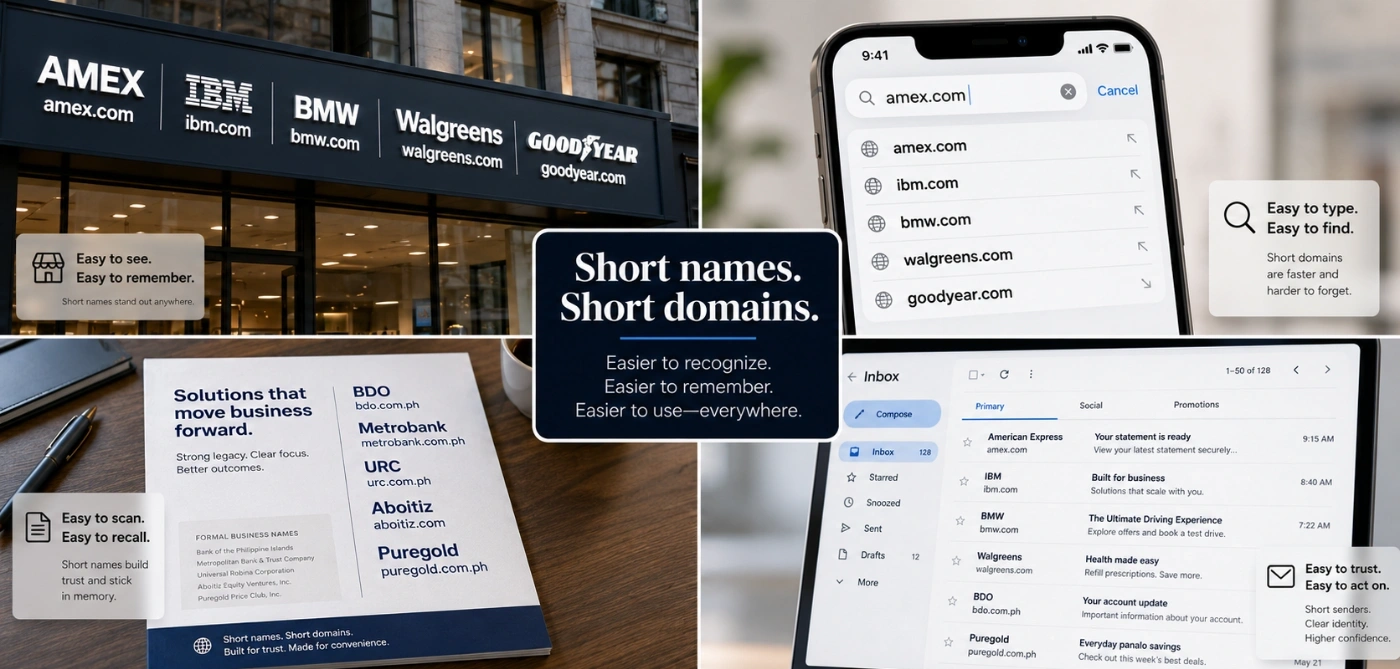
Short Domains Look Better in Marketing Materials
Domains appear almost everywhere a brand appears. They are used in posters, receipts, brochures, tarpaulins, vehicle wraps, store signs, email footers, and presentation slides.
- Short domains fit better in tight design spaces.
- They can be printed larger and read faster from a distance.
- They are less likely to wrap awkwardly across multiple lines.
- They compete less with the logo, headline, and call to action.
- They make layouts look cleaner and more premium.
Short Domains Improve Email Usability
The domain is not only used for the website. It is also used in email addresses, which makes length even more important.
- Short domains make email addresses easier to read, type, and verify.
- They look cleaner on business cards and email signatures.
- They reduce mistakes when customers fill out forms or send inquiries.
- They make departmental emails more practical, such as [email protected], [email protected], [email protected], and [email protected].
- Long domains make email addresses visually messy and harder to spell over the phone.
Short Does Not Mean Vague
Short is not the only goal. A domain should also be clear, relevant, and aligned with the brand.
- A short but confusing domain is not better than a slightly longer but meaningful one.
- The goal is to remove unnecessary complexity, not to remove meaning.
- The best domain is the shortest version that customers naturally associate with the business.
- Use a familiar acronym only if customers already recognize it.
- Use the main consumer-facing brand when that is what customers know.
Words to avoid unless truly needed:
- corporation
- incorporated
- company
- holdings
- ventures
- group
- long industry descriptors
Domain Decision Checklist
Before choosing a domain, ask these questions:
- Can customers remember it after hearing it once?
- Can someone type it correctly on a phone without struggle?
- Can a salesperson say it over the phone without spelling every word?
- Does it match the name customers actually use for the brand?
- Does it avoid unnecessary legal words such as “inc,” “corporation,” or “company”?
- Will it look clean on business cards, signs, flyers, email signatures, and ads?
- Will it be easy to verify as the official website?
- Will the same domain work well for email addresses?
- Is it short without becoming vague or confusing?
- Does it reduce friction across the full customer journey?
Conclusion
When choosing a domain name, the goal is not just to pick the shortest option, but to choose the name that best balances branding, clarity, trust, memorability, and long-term marketing value. If you are planning to build, redesign, or upgrade your website, NetizenWorks can help you evaluate your domain options alongside the actual website strategy, so your domain, design, content, SEO, and customer journey work together. Consult with us and we can guide you in choosing a domain name that feels professional, is easy for customers to remember, and supports the kind of website your business needs to grow.