
Why Fully In-Housing Your Website May Create More Risk Than Control

Before finalizing the decision to move the website and related digital operations fully in-house, it is worth separating two different ideas: building internal marketing capability and taking over full website operations.
Those are not the same thing.
An internal marketing team can be very useful. It can help with product priorities, promotions, brand direction, sales coordination, content planning, and campaign ideas. But the website itself is not only a marketing asset. It is part of the company’s sales infrastructure, lead generation system, product catalog, inquiry handling process, analytics setup, hosting environment, security posture, maintenance workflow, and future ecommerce capability.
In simple terms, a website is not just something the company “owns.” It is something the company must continuously operate.
That distinction matters because moving a website fully in-house does not automatically improve marketing results. In many cases, it only shifts technical responsibility to an internal team that may not have the systems, time, documentation, or experience needed to manage it properly.
The actual issue is usually not ownership, it is active use
A website by itself does not market the business.
It does not automatically generate demand, run ads, follow up with leads, create campaigns, improve product positioning, or educate customers. A website is the infrastructure that marketing sends traffic to. It works best when supported by a combination of internal business knowledge and external technical execution.
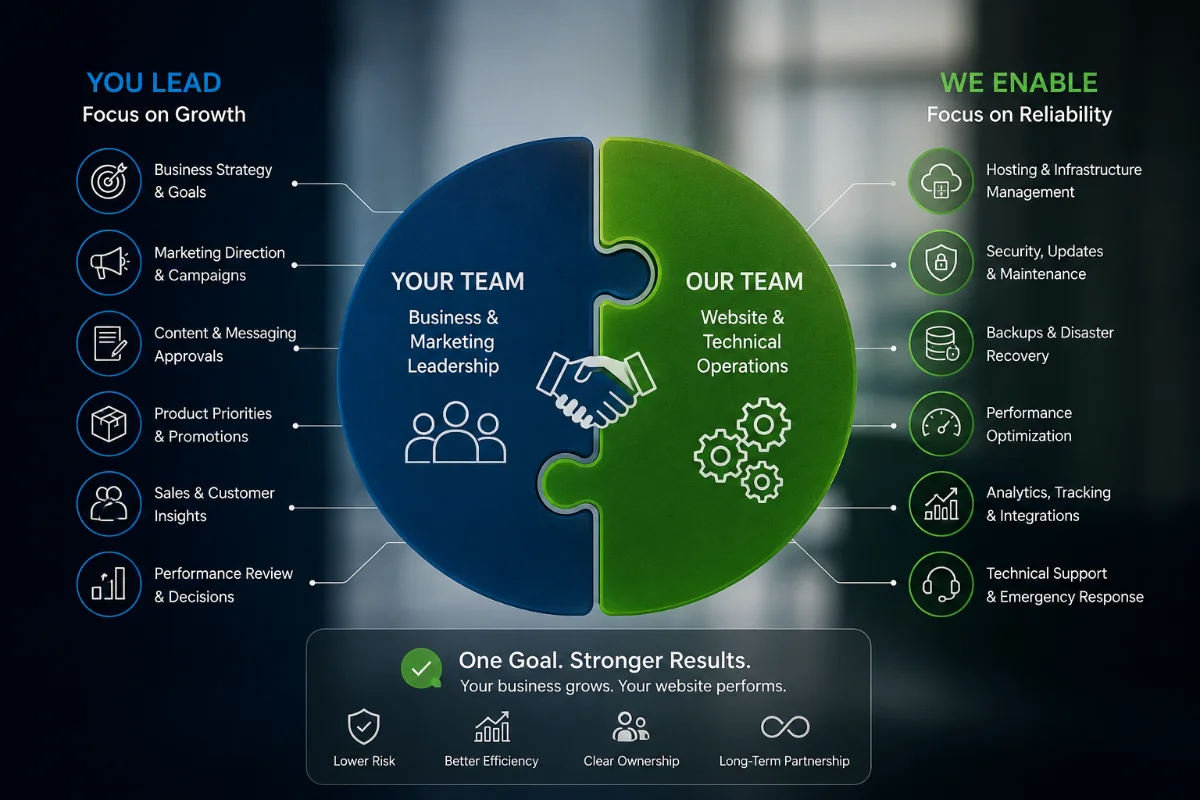
For any type of businesses, a supplier or distributor, the internal team should focus on business direction: which products to promote, which markets to target, what sales teams need, what customers ask about, what dealers or commercial buyers care about, and what campaigns should be prioritized.
The website provider should focus on the technical layer: hosting, maintenance, uptime, performance, security, WordPress and WooCommerce updates, plugin compatibility, backups, form reliability, landing pages, analytics continuity, and future ecommerce readiness.
The stronger setup is not “everything internal” or “everything outsourced.” The stronger setup is usually hybrid: internal marketing leadership supported by a specialist web operations partner.
That is also consistent with current market behavior. Marketing Week reported in 2025 that 63.1% of more than 3,500 respondents had outsourced work to an agency or third party in the past 12 months, including 67.5% of B2B brands and 62% of SMEs. This suggests that agency support is not a step backward. It remains a normal business practice, especially when companies need specialist capability without building every function internally.
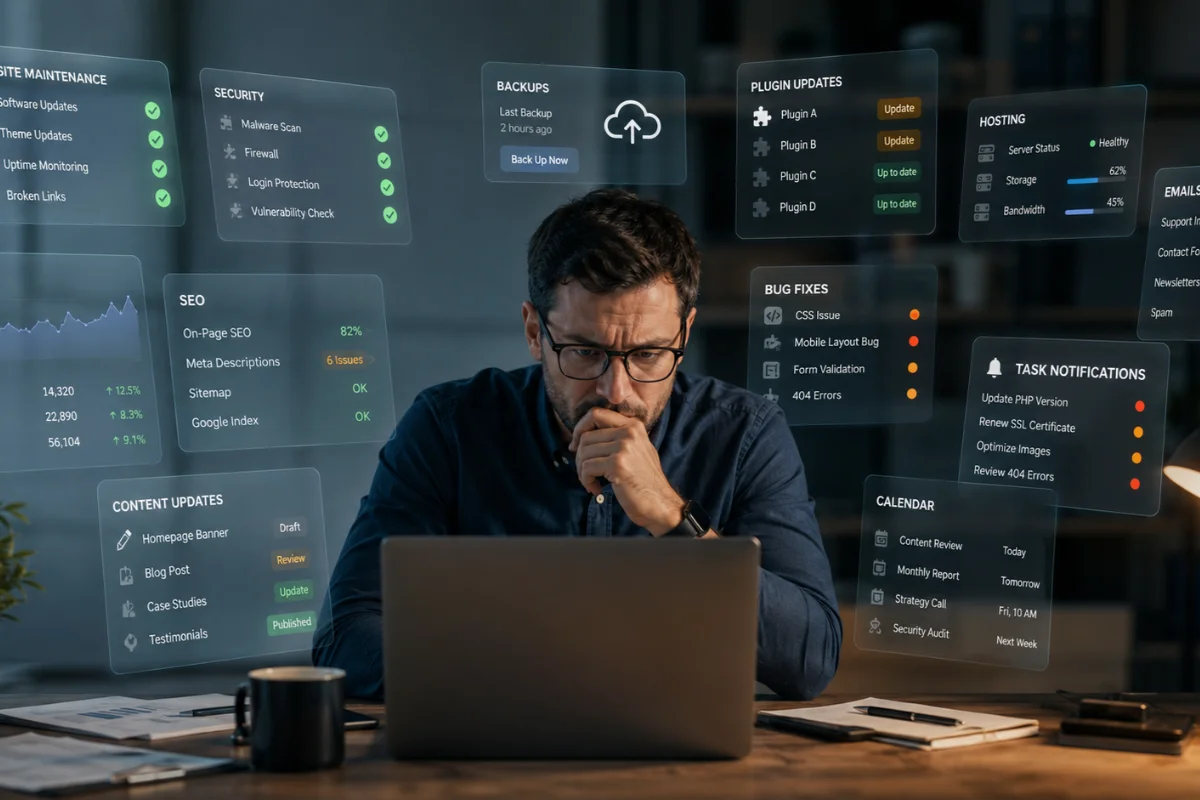
In-housing creates more responsibility than most companies expect
The concern is not only that the company might hire the wrong IT person. That is just one risk.
The larger issue is that fully in-housing the website creates an entire operational responsibility that must be managed every month, whether or not the company is actively thinking about the website.
A business website needs:
- Hosting management
- Domain and DNS access control
- WordPress updates
- WooCommerce updates
- Plugin and theme updates
- Security monitoring
- Backup verification
- Recovery procedures
- License tracking
- Form testing
- Email deliverability checks
- Analytics and tracking continuity
- Landing page support
- Speed and performance optimization
- SEO structure preservation
- Redirect management
- Staging before major updates
- Documentation
- Access control
- Emergency troubleshooting
These are not glamorous tasks, but they are what keep the website stable.
The danger is that internal teams often prioritize visible tasks, such as posts, product announcements, promotions, catalogs, or sales requests. Meanwhile, invisible technical tasks like backups, plugin compatibility, security updates, analytics tracking, and form testing get delayed because nothing looks broken yet.
That is how technical debt builds.
By the time the problem becomes visible, the company may already be dealing with broken forms, missing leads, plugin conflicts, expired licenses, slow pages, malware, lost access, corrupted layouts, or SEO decline.
A website is a business system, not a one-time project
A common mistake is treating the website as something that can be “finished.”
In reality, a website is closer to a business system than a brochure.
It changes whenever WordPress updates. It changes whenever WooCommerce updates. It changes whenever plugins update. It changes when browsers, PHP versions, Google Analytics, search behavior, security threats, customer expectations, and campaign requirements change.
WordPress remains widely used, which is one of its strengths. W3Techs reported on June 24, 2026 that WordPress is used by 41.5% of all websites and 59.3% of websites whose CMS is known. It also reports WooCommerce as a major WordPress subtechnology, used by 19.8% of WordPress sites.
That popularity is an advantage because WordPress and WooCommerce are flexible, extensible, and upgradeable. But it also means the system needs proper maintenance. A WordPress/WooCommerce website is not something to casually hand to “someone who knows computers.”
That is like giving an air-conditioning maintenance contract to someone because “he knows electricity.” Technically related, operationally dangerous.
The risk is operational fragility
The biggest risk of fully in-housing the website is operational fragility.
If one internal employee becomes responsible for the website, the company may become dependent on that person’s memory, habits, notes, login access, and personal understanding of how the system works.
If that person resigns, gets reassigned, loses access, or leaves without proper documentation, the company may lose institutional knowledge about:
Where the website is hosted
Which plugins are critical
Which licenses are active
Which custom functions were built
Which forms send to which emails
Which accounts own analytics and tracking
Which DNS records are important
Which backups are reliable
Which changes were made manually
Which pages are important for SEO
Which parts should not be edited casually
This is how companies end up with websites they technically own but cannot safely operate.
The concern is not client ownership. Client ownership is good. The concern is placing a business-critical digital asset under a single internal point of failure.

Security is not optional
Security is one of the clearest reasons to keep a specialist web partner involved.
The U.S. Small Business Administration specifically recommends multi-factor authentication because usernames and passwords alone are not enough to verify identity. This matters for website admin accounts, hosting, domains, email, analytics, ad accounts, and other digital assets connected to the business.
For WordPress specifically, security is not theoretical. Patchstack’s 2026 State of WordPress Security report states that 11,334 new vulnerabilities were found in the WordPress ecosystem in 2025, a 42% increase from 2024. It also reported that 91% of new vulnerabilities were found in plugins, and 46% of vulnerabilities did not receive a patch by the time of public disclosure.
That does not mean WordPress is bad. It means WordPress must be maintained properly.
The risk usually comes from poor maintenance, abandoned plugins, weak passwords, missing MFA, outdated components, untested updates, insecure permissions, and lack of monitoring.
OWASP, a major application security organization, lists security misconfiguration as a major web application risk. Its examples include missing hardening, unnecessary features being enabled, default accounts, insecure settings, missing security headers, and outdated or vulnerable software. OWASP also says systems are at higher risk without a repeatable application security configuration process.
That is exactly why website operations should not be treated as a casual internal task.
Agencies provide depth, not just labor
A major advantage of staying with an agency is that the company is not relying on a single person.
A proper agency gives access to a mix of capabilities:
- Website strategy
- Design judgment
- WordPress development
- WooCommerce configuration
- Hosting knowledge
- Plugin troubleshooting
- Security practices
- Backup and recovery procedures
- Landing page creation
- Analytics support
- SEO structure awareness
- Performance optimization
- QA and testing
- Technical documentation
Hiring one internal staff member rarely gives all of those skills.
An internal marketing employee may be good at campaigns, content, coordination, or brand execution. That does not mean they should also be responsible for hosting, security, DNS, plugin conflicts, website recovery, WooCommerce logic, analytics tracking, and technical troubleshooting.
A website agency is not just another pair of hands. It is a working system built from repeated exposure to different websites, different technical problems, different hosting environments, different plugin conflicts, and different client requirements.
That experience matters because many website problems are pattern-recognition problems. An agency that manages websites regularly is more likely to recognize issues faster, resolve them more cleanly, and avoid repeating mistakes that an internal team may still have to learn through trial and error.
Outsourcing is not just a cost-saving tactic anymore
The old reason to outsource was simple: reduce cost.
That is no longer the only reason.
Deloitte’s 2024 Global Outsourcing Survey says organizations use different sourcing models to access talent, skills, and capabilities, and its report focuses on the need to govern an extended workforce ecosystem.
Clutch’s 2025 Small Business Growth Playbook reported that 84% of SMBs were already outsourcing at least some operations, while 70% expected increased reliance on external partners. It also found that 45% of SMB decision-makers anticipated outsourcing marketing and advertising, reflecting the difficulty of keeping up with changing marketing technologies and accessing specialized talent without in-house overhead.
This matters because the modern agency relationship is not simply “do this task cheaper.”
The better agency relationship is:
- Access to specialist knowledge
- Faster implementation
- Lower fixed employment burden
- Continuity across staff changes
- Better tools and processes
- Flexible support
- Reduced management load
- Broader technical exposure
- More reliable documentation
- External accountability
For a company, this is a practical business decision. The company should not need to build a full internal web operations department just to keep the website stable and ready for growth.

Internal teams should own direction, agencies should own technical execution
The best model is not agency dependence.
The best model is clear division of responsibility.
The internal team should own:
- Business priorities
- Product focus
- Brand direction
- Promotions
- Campaign concepts
- Sales team feedback
- Customer insights
- Content approvals
- Product catalog decisions
- Lead handling process
The agency should be responsible for:
- Hosting
- Maintenance
- Security
- Backups
- Website updates
- Plugin licenses
- E-Commerce readiness
- Technical fixes
- Performance
- Landing page implementation
- Analytics setup
- Form testing
- Website recovery
- Technical documentation
This allows the company to gain more control without absorbing unnecessary technical risk.
It also avoids a common internal problem: giving marketing staff technical responsibilities that distract them from actual marketing.
The marketing team should be spending its energy on generating demand, improving offers, coordinating with sales, promoting products, running ads, and improving customer communication. It should not be spending time figuring out why a plugin update broke a product layout or why inquiry forms stopped sending emails.
Starting from scratch may waste existing value
Starting over can feel clean. But clean does not always mean smart.
If the current website is already built on WordPress and WooCommerce, then the company already has a foundation that can be upgraded. Even if the current site is catalog-only, WooCommerce gives it a path toward stronger product management, future ecommerce, product inquiry flows, quote requests, dealer pages, promotions, landing pages, and eventually transaction support.
Rebuilding from zero means the company may need to recreate:
- Website structure
- Product catalog setup
- Design system
- Custom plugins or custom functionality
- Forms
- Tracking
- SEO structure
- Redirects
- Hosting setup
- Security setup
- Plugin stack
- License stack
- Content formatting
- Existing technical decisions
A rebuild may still be appropriate in some cases, but it should be justified by a clear business reason. It should not be done simply because the company wants the website “in-house.”
A rebuild does not automatically improve marketing performance. If the website is rebuilt but still not supported by campaigns, ads, content, tracking, sales follow-up, and active product promotion, the result may be a newer website with the same business problem.

In-housing can increase fixed costs
At first, moving in-house can look cheaper.
But the real cost is not just the salary of one person.
The company may also need to account for:
- Recruitment time
- Training
- Management supervision
- Software subscriptions
- Premium plugins
- Hosting
- Security tools
- Backup systems
- Developer support
- Design tools
- Analytics tools
- Documentation time
- Emergency troubleshooting
- Staff turnover
- Lost time when internal people are unavailable
- Cost of mistakes
- Cost of rebuilding abandoned work
Agencies spread systems, tools, and technical learning across multiple clients. That can make the setup more efficient than building the same capability internally for one website.
This is especially true when the website work is important but not constant enough to justify a full internal web operations role.
A mid-sized supplier may need reliable website operations every month, but not necessarily enough technical work to fully utilize a dedicated in-house web specialist. That creates an awkward situation: either the company hires someone too junior and exposes the site to risk, or hires someone qualified but underuses them.
Both are inefficient.
Agencies protect continuity
Continuity is one of the most underrated reasons to stay with an agency.
Employees resign. Internal roles change. Priorities shift. Staff get overloaded. Knowledge gets lost. Passwords are forgotten. Documentation gets outdated. Managers assume “someone knows how it works” until that person leaves.
An agency reduces that risk because the operating knowledge is not supposed to live in one employee’s head.
A proper agency setup should have:
- Shared internal documentation
- Multiple people familiar with the account
- Standard maintenance processes
- Backup and recovery procedures
- License records
- Hosting records
- Change logs
- Repeatable update workflows
- Escalation paths
That gives the company continuity even when individual people change.
The goal is not to make the company dependent on the agency. The goal is to prevent the website from becoming dependent on a single internal employee.
Agencies give external perspective
Internal teams are close to the business, which is useful.
But being close to the business also creates blind spots.
An external web partner can question assumptions, compare patterns across other websites, spot technical risks earlier, and recommend improvements based on broader exposure.
This is especially useful for companies that sell technical products, commercial systems, or product lines for large buyers.
The internal team knows the products and customers. The agency knows how to structure digital assets so those products can be found, understood, promoted, tracked, and converted into inquiries.
That combination is stronger than either side working alone.
Marketing needs the website, but marketing should not be forced to become website operations
It is correct to bring more marketing effort inside the company.
But internal marketing and website operations are different disciplines.
Marketing staff can coordinate promotions, campaigns, social content, product highlights, dealer support, and sales enablement. But the website needs a technical operating layer behind it.
Modern marketing is also becoming more technical. HubSpot’s 2026 State of Marketing report notes that more marketers understand how to use AI in marketing and measure AI impact compared with 2025, showing how fast marketing tools and expectations are changing.
This is another reason not to overload internal marketing staff with website operations. Their job is already becoming more complex. They should be focused on strategy, content, campaigns, automation, audience targeting, and lead quality, not plugin conflicts and hosting issues.
The better recommendation: hybrid ownership
The safest and most practical recommendation is:
Build internal marketing capability, but keep website operations with a specialist web agency.
This gives the company:
- More control over business direction
- Better marketing coordination
- Faster product and campaign decisions
- Continued website stability
- Lower technical risk
- Better security continuity
- Better access to specialist skills
- Less dependence on one internal employee
- A clear path to ecommerce upgrades
- A partner already familiar with the existing system
This model respects client ownership while protecting the website as a business-critical system.
What a proper in-house transition would require
If the company still decides to move the website fully in-house, the transition should not be treated as a simple file handover.
It should be treated as a formal operational risk transfer.
At minimum, the company should prepare:
- Company-owned hosting account
- Company-owned domain account
- Company-owned admin emails
- Password manager
- Multi-factor authentication
- Access recovery process
- DNS documentation
- Plugin and license inventory
- Custom plugin documentation
- Backup system
- Backup restoration test
- Staging environment
- Update procedure
- Security monitoring
- Form testing procedure
- Analytics and tracking ownership
- Search Console ownership
- Ad account continuity
- Written operating procedures
- Named accountable technical lead
- Emergency support plan
- Budget for future plugin renewals
- Budget for unexpected technical fixes
Without these, the move is not really “bringing the website in-house.”
It is simply moving a technical system into a less controlled environment.
Final recommendation
The company should not confuse website control with website operation.
It makes sense for the internal team to control the business direction of the website. They should decide which products to promote, which campaigns to prioritize, what content matters, and how the site should support sales.
But the technical operation of the website should remain with a specialist web partner unless the company is prepared to build and maintain a proper internal web operations function.
For any company, the website should support the business, not become a technical burden.
NetizenWorks’ recommendation is a hybrid setup: the client retains business and marketing control, while NetizenWorks continues managing hosting, maintenance, security, backups, technical updates, plugin licenses, performance, analytics continuity, emergency support, and future ecommerce upgrades.
This is not about preventing internal growth. It is about avoiding a preventable operational problem later.
A website can be handed over easily. A reliable website operation is harder to rebuild once knowledge, access, licenses, systems, and accountability become fragmented.